


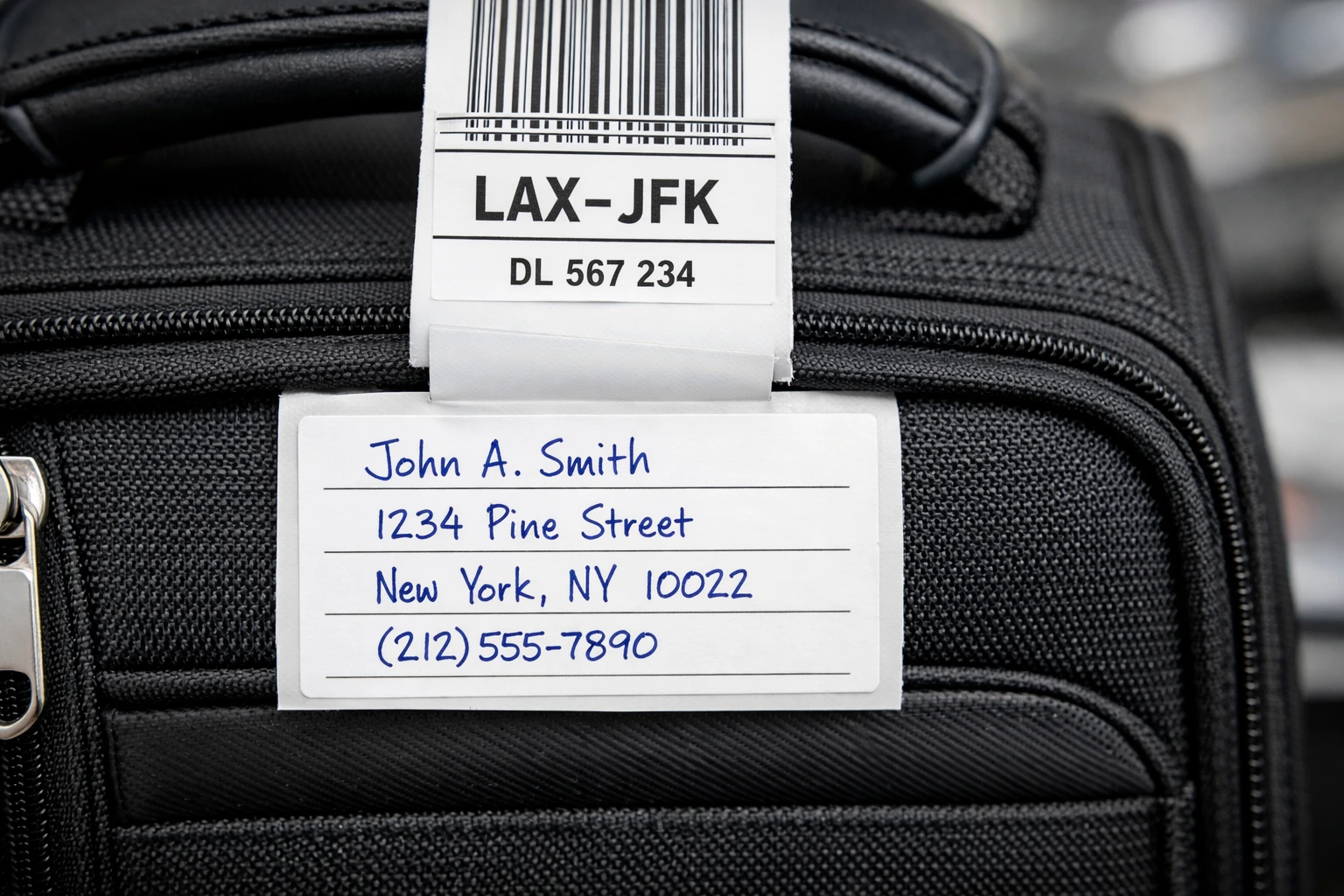
Resolution 741 – Passenger Name and Address Label
Overview: IATA Resolution 741 is a legacy passenger-service standard requiring airlines to provide name-and-address labels (small adhesive tags) for checked baggage. Each label bears the passenger’s name (matching the ticket) and a contact destination address, enabling a misplaced bag to be returned to its owner. By design it supplements (and is attached beneath) the main IATA baggage tag. In practice it ensures every checked bag carries an owner identifier – a measure that dramatically aids loss recovery. (Today the same data is often encoded on the baggage tag itself, but the original resolution persists.) [2][4]
Historical Origin
Resolution 741 was first adopted at the 27th IATA Passenger Services Conference. It came into force on 15 December 1972 [1]. The text in the PSC Resolutions Manual is coded “PSC(27)741”, indicating the 27th conference. Since adoption it has remained in effect without expiration (“Expiry: Indefinite”) [2] and is unchanged in current manuals.
Key Details of Resolution 741
Resolution
741 – Passenger Name and Address Label
Adopted
27th Passenger Services Conference – 15 Dec 1972
Purpose
Ensure every checked bag carries owner ID (name, address, contacts) to speed recovery of delayed or lost baggage
Implementation
Airlines must offer a label or sticker at check-in for each bag where passenger enters name, initials, optional address/phone/email
Technical Specs
Label face material 50.8 mm width; adhesive backing; space for family name, initials and optional contact details
Monitoring
Local Baggage Committees monitor monthly availability and usage by all carriers
Status
Indefinite (no expiry)
Benefit
Improves recovery of mishandled baggage and reduces passenger inconvenience
Purpose and Rationale
The core goal of Resolution 741 is lost-bag recovery. By requiring a visible owner identifier on the bag, it ensures that stray or unclaimed baggage can be traced back to the passenger. If a bag arrives at the wrong city or remains unclaimed, staff can read the label and reroute the bag to the passenger’s destination or address. This simple measure complements modern tracking technologies such as barcodes and RFID.
IATA reports that baggage mishandling declined from 18.88 per 1,000 passengers in 2007 to 5.57 by 2017 [7], and that approximately 99.6% of the ~4 billion bags carried annually arrive on time [8]. In this context, Resolution 741 functions as a legacy fail-safe that remains relevant even in highly automated baggage environments.
Technical Structure
The name and address label is a small adhesive tag attached beneath the main baggage tag. IATA specifications define the label as using 50.8 mm face material with a feed hole, as shown in Attachment U of the PSC Resolutions Manual [4]. The label provides space for the passenger’s family name and initials (mandatory) and optionally contact address, telephone number and email [3].
The label must be visually distinguishable from the baggage tag so it cannot be mistaken for an official tag. While many airlines now print passenger details directly on barcode tags, the legacy format of a separate contact label remains permissible and compliant.
Implementation Guidelines
Resolution 741 requires airlines to make name and address labels or self-adhesive stickers available at check-in or ticketing for each checked bag [3]. Passengers are instructed to write their family name (matching the ticket), initials, and optional contact details, preferably using Latin characters for international readability.
The passenger affixes the completed label to the exterior of the bag beneath the main IATA baggage tag. If a bag has no identifying name, the passenger must affix one before acceptance [9]. Resolution 741 also encourages printing baggage-safety reminders on or with the label to reduce pilferage [10][11].
Benefits for Airlines
Passenger name and address labels significantly enhance recovery rates for misdirected baggage by providing a human-readable identifier when automated tracking fails. Ground staff can quickly identify ownership in unclaimed baggage rooms, remote airports, or system outages.
This redundancy improves operational efficiency, reduces compensation costs, and supports regulatory compliance under liability frameworks such as the Montreal Convention.
Auditability and Monitoring
Compliance with Resolution 741 is monitored through IATA Resolution 744, which assigns Local Baggage Committees responsibility for monthly checks ensuring labels are available and used by all carriers serving an airport [5][6].
Audit activities include inspections of check-in counters, baggage handling procedures, and review of mishandling cases to confirm effectiveness. Resolution 741 is therefore self-enforcing within the IATA framework.
Real-World Use Cases
In misrouted transfer scenarios, receiving airlines can use the name label to identify and contact the passenger or reroute baggage quickly. At large hubs, labels assist staff in grouping unclaimed bags by owner during major disruptions. At smaller airports without advanced IT systems, labels enable manual delivery to passenger addresses.
Example: A passenger traveling on a multi-leg itinerary attaches a Resolution 741 label with her hotel address. When her bag misses the final connection, staff at the intermediate airport use the label to contact the destination hotel and forward the bag the next day, minimizing inconvenience.
Amendment History
Resolution 741 has remained unchanged since its adoption at PSC 27 in 1972. It carries an indefinite expiry and no amendment circulars have been issued [2]. Operational practices have evolved, but the core requirement remains intact.
Conclusion
Resolution 741 is a long-standing IATA standard ensuring every checked bag carries visible owner identification. Though simple in design, it delivers substantial benefits in baggage recovery, customer service and operational resilience. Even in the era of RFID and global tracking, the passenger name and address label remains a practical, passenger-centric safeguard.
References
- Artifacts of Soviet Aeroflot – Baggage Tags (1972 context)
- IATA Passenger Services Conference Resolutions Manual
- T324$$CH02 – IATA Resolution 741 Text
- PACRM – Attachment U, Label Specifications
- IATA Resolution 741 Clause 5
- IATA Resolution 744 – Local Baggage Committees
- IATA Baggage Mishandling Statistics
- IATA Travel & Baggage Data
- Passenger Identification Requirements
- Baggage Tips Advisory Text
- Pilferage Prevention Guidance
- IATA Baggage Standards Portal

Author: John Karume
John Is a Baggage Operations and Systems expert with 15+ years of airline experience who leverages People, Process, Technology to deliver measurable improvements. He builds innovative tech solutions, from Baggage Systems, LMS and educational sites to business process automation and full-stack software integrations—and is a Power BI, Excel, and Tableau guru as well as a full-stack web and software developer. A Certified Lean Black Belt, Business Analyst, Aviation Auditor and Quality Control specialist, John combines operational insight with technical delivery to keep systems efficient and baggage moving on time.
Contact: john.karume@baggagelogistics.com | https://www.fiverr.com/s/o8G3q2x
Comments (0)