


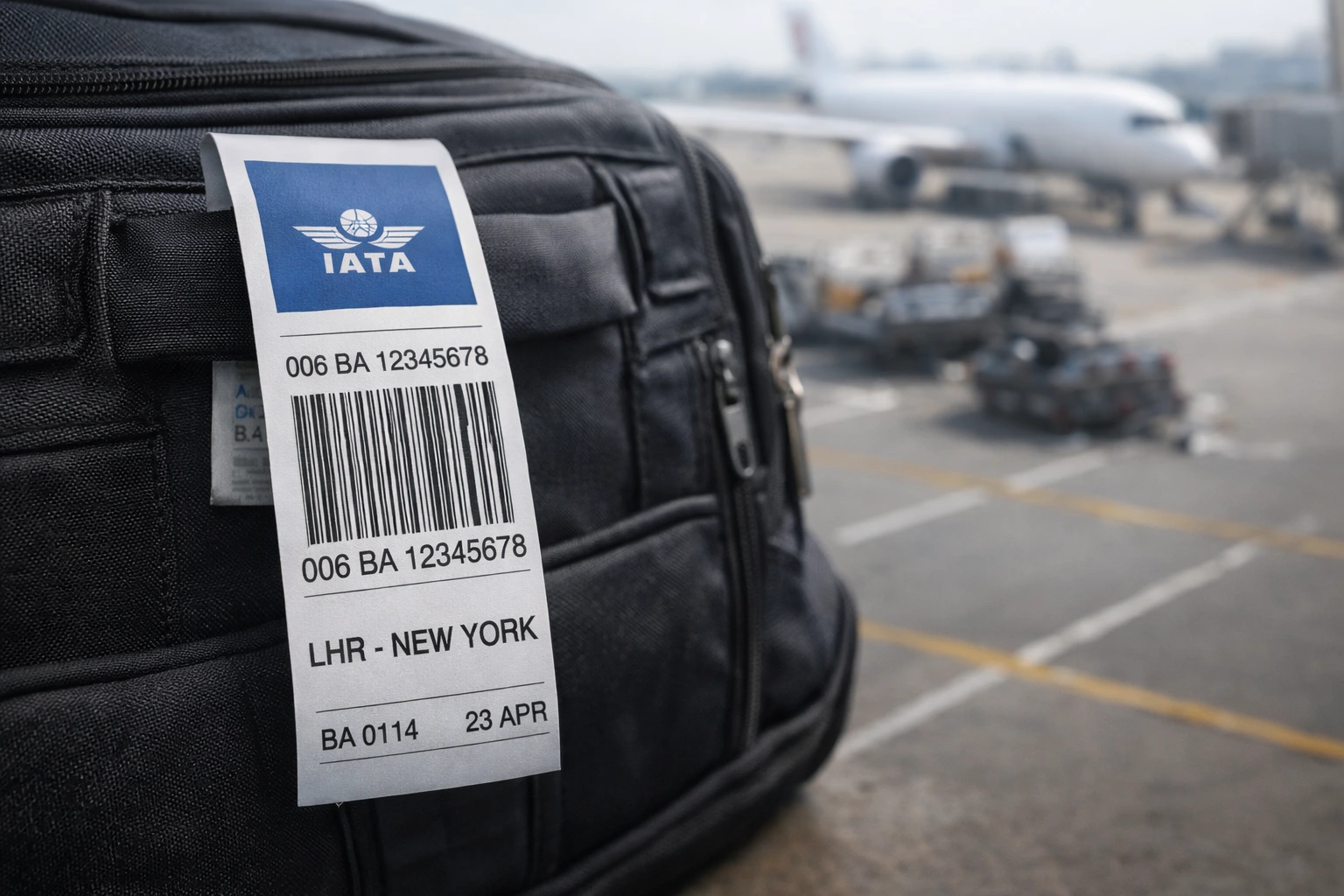
IATA Resolution 740: Form of Interline Baggage Tag
Resolution 740 is the IATA standard specifying the format and content of interline baggage tags used on every checked bag that travels across airlines. In practice, each checked bag must carry an airline-issued tag conforming to Res. 740, including a full 10-digit license-plate number (the leading digit, the three-digit Baggage Tag Issuer Code, and a six-digit serial). This license-plate number is encoded in both human-readable text and in the tag’s bar code. The baggage tag must remain attached to the bag throughout its journey. By prescribing a common tag design, Res. 740 enables automated scanning and tracking of bags across airport systems and partner carriers [1][2]. The IATA Baggage Standards page lists “Resolution 740 – Form of Interline Baggage Tag” among its binding industry resolutions [3], reflecting that all IATA members must comply. [1]
Origin and Evolution
Resolution 740 was first adopted in 1962 at an IATA Passenger Services Conference in Cannes [4]. Prior to that, bag tags were simple paper tags, but by the early 1960s airlines needed a common standard as automated sortation systems emerged. Since 1962, Res. 740 has continuously evolved to keep pace with technology (notably adding bar code and now RFID support) [5]. Each update is member-driven via IATA conferences or amendment circulars. For example, detailed tag dimensions and attachments were codified in the 26th edition of the PSC Manual (June 2006). In 2020 the Baggage Working Group adopted further amendments – adding an RFID tag design (“Attachment G”) and updating perforation and form-feed specifications [6][7]. [1]
In summary, Res. 740’s “original adoption” date is 1962, and major revisions have been issued in subsequent PSC cycles (often via circulars). The amendment history can be traced in each PSC Resolutions Manual edition. For example, the 2020 Conference approved changes effective thereafter (increasing the tag perforation strength to 70 N/54 mm, and adding an IATA-standard RFID tag layout) [6][7]. (Airlines and implementers refer to the manual’s amendment tables for exact dates of each change.) [1]
Tag Structure and Components
Under Res. 740, every interline baggage tag must carry five main sections: [8]
Tag Number (License-Plate Number, LPN): a unique 10-digit code, composed of a 1-digit prefix (tag type), the 3-digit Baggage Tag Issuer Code (the airline’s numeric code), and a 6-digit serial number [1]. This full 10-digit LPN is encoded in the tag’s bar code and printed in numeric text. By resolution, only this complete LPN is used for all baggage messaging and remains unchanged for the bag’s entire journey [9][1]. [1]
Information Area: passenger and issuance details (name, airline agent or station, and other tag issuance info) [8]. This area typically includes a barcode or machine-readable fields containing the LPN. [1]
Routing Area: flight routing information – the bag’s final destination and any transfer points [8]. [1]
Identification/Claim Portion: a stub of the tag that is attached to the passenger’s ticket or given as a claim check [8]. It carries a copy of the tag number and routing. [1]
Removable Stubs: portions of the tag meant for baggage reconciliation (e.g. left on a cart or at an intermediate point) [8]. [1]
These sections are often laid out on an “accordion-style” tag with perforations or folds, as shown in IATA’s diagrams [8][10]. The PSC Manual attachments define precise tag dimensions. For instance, the tag’s face material width must be between 50.8 mm and 54.0 mm [10], and the hole position, stub perforation, and spacing are specified in detail. (As an example, Attachment T of Res. 740 shows a 54.0 mm tag with a 50.8 mm face width [10].) [1]
A key element is the license-plate number. The first leading digit of the 10-digit LPN indicates the tag type (per Res. 740b and Res. 751): [1]
Leading Digit — Tag Type / Use (Res. 740b):
0 — Interline baggage tag (standard use) [11]
1 — Fallback (manual) tag [11]
2 — Expedite (“RUSH”) tag [11]
3–9 — Additional series for online or expanded interline use [11]
This 10-digit LPN is mandatory on each tag. It is printed clearly and encoded in the bar code to support automated systems [1][12]. (For auditability, IATA even requires that the full 10 digits be used in all exchanges and not truncated.) [1]
Implementation Guidelines
Resolution 740 does not just give a number format; it mandates the printing and scannability standards for tags. Among its provisions:
Printing and Materials: Tags must be printed on durable paper stock with adhesive backing (tags are typically fan-folded in rolls or books). IATA recommends high-quality printing so that bar codes and human-readable text remain legible after rough handling [8][10]. Tag layouts include defined form-feed areas (gaps) between tags and perforation strength requirements. (For example, the 2020 revision raised the maximum perforation tear strength to 7.2 kg/54 mm [13] to ensure tags remain attached during transport.) [1]
Symbology: The LPN is encoded in a linear bar code (e.g. Code 128 or similar) and must be present on each tag. By resolution, all interline tags support optical scanning: “Resolution 740 defines the requirement for interline baggage tags supporting optical scanning” [12]. In practice this means baggage handlers can use fixed or handheld scanners to read every tag’s bar code at check-in, bag drops, sorters, etc. [1]
Alternative Reading Methods: Res. 740 also explicitly covers non-barcode methods. For instance, it states that tags must support manual recording (the human-readable number) [14], OCR scanning (image-based recognition) [15], and even RFID chips. In fact, the 2020 update added a standard RFID tag layout (Attachment G) so tags can carry both bar codes and an RFID chip [7]. IATA guidance confirms: “Resolution 740 defines the requirement for interline baggage tags supporting... RFID scanning” [16]. (Separate IATA Recommended Practice 1740c provides detailed RFID specs, but Res. 740 governs the tag form.) [1]
Data Placement: Res. 740 and its Recommended Practices (RP1740 series) specify what information goes where. For example, the bar code should encode the license-plate number (and optionally an alphanumeric human-readable translation) as shown in the standard examples [17]. The tag must also include a human-readable numeric translation of the LPN near the bar code (often used by OCR machines). Section 5 of Res. 740 lays out these requirements (and is summarized in [42†L720-L724]). [1]
By following these guidelines, any IATA-member bag tag can be scanned and interpreted by any compliant airline or airport system. For instance, an airport’s baggage handling system will read the barcode and instantly know the bag’s license plate, origin carrier, and destination, thanks to the common Res. 740 format [1][2]. [1]
Benefits for Airlines and Airports
The standardized interline tag brings several benefits:
Universal Track-and-Trace: Every Res. 740 tag carries the same kind of data, so airports and airlines worldwide can interchangeably scan and log bags. This enables end-to-end traceability. The 10-digit LPN serves as a “linking pin” between baggage and passenger records [18]. As one analysis notes, baggage tracking messages (BSMs) are exchanged at each handling point, always referencing the same LPN [18]. This means any party can locate the bag in the system simply by its license-plate number. [1]
Speed and Accuracy: With the common format, fixed and handheld scanners at gates, conveyors, and carousels can process bags automatically. For example, IATA’s Baggage Tracking guide notes: “All baggage is today identified with a barcode”, making optical scanning the most common method [2]. (Manual fallback is supported in emergencies [14], but automated scans vastly reduce delays.) Barcode (or RFID) reading speeds up sorting and gate-check processing. [1]
Lower Mishandling: Standard tags reduce lost/misrouted bags. Airline and industry reports emphasize that adopting bar-coded and RFID tags has dramatically cut mishandlings. (RFID tags in particular can be read in bulk without line-of-sight [19], raising read rates to ~100%.) Avery Dennison notes that airports using IATA-compliant RFID tags (meeting Res. 740/753) have cut loading time and handler errors [20][21]. Every saved minute and error avoided directly saves costs (handling one mishandled bag can cost ~$100 [22]) and improves passenger satisfaction. [1]
Interline Coordination: Because Res. 740 is agreed industry-wide, partner airlines and handling agents all “speak the same language.” When a bag is handed from one carrier to another, the receiving carrier can scan the tag and update their system with confidence. For example, if a bag is re-tagged (during involuntary reroute), the new tag still uses the same 10-digit LPN (often the original license plate is carried forward or the new tag uses the same issuer code) [18]. This helps in interline scenarios, baggage exchanges, and when baggage is transferred at an intermediate airport. [1]
Compliance and Safety: Having a single tag format simplifies compliance with security and aviation rules. For instance, authorities can require that tags meet Res. 740/RP1740a standards. This uniformity supports baggage screening and customs processes globally. [1]
Auditability and Tracking
Because every scanning/handling event records the LPN, airlines have a complete audit trail of each bag’s journey. At check-in and bag-drop, the agent scans the Res. 740 tag and registers the LPN in the Departure Control System. Later, if a bag is mishandled or delayed, staff can query baggage systems by that license-plate number. IATA notes that the LPN is included in the standardized Baggage Service Messages (BSM) exchanged between DCS, baggage sorters, and handling systems [18]. In essence, the bag’s tag number becomes a permanent identifier in all interline baggage messages. [1]
This auditability means management can reconcile which bags reached each gate or carousel. For example, if a bag was accepted at Gate 12 for Flight XYZ123 (Outbound), there will be a scan record with that LPN. If it later appears in Lost & Found, handlers can trace it back through the scanning log. Conversely, carriers can prove a bag was offloaded or misrouted by showing its last scan point. The standardized tag thus underpins data-driven baggage reconciliation and KPI tracking in operations. [1]
Real-World Use Cases
Rush/Expedite Baggage: If a bag is misconnected at an intermediate airport, an airline may attach a “RUSH” expedite tag. IATA’s guidance specifically cites Resolution 740: “An automated and printed on demand form of label (IATA Res 740) is used by many carriers” for RUSH luggage, and that these tags carry unique coding so that “the RUSH tag [can] be identified by scanning systems” [23]. In practice, the station prints a Res. 740-compliant tag marked “RUSH” with the same license-plate format. Ground handlers can then scan these expedite tags to route the bag on the next available flight, even if it’s a partner airline. Because Res. 740 is global, any carrier’s system can read the RUSH tag and expedite delivery to the passenger’s final destination. [1]
Interline Transfers: Consider a passenger itinerary involving two carriers (A then B). Airline A will issue a Res. 740 tag at check-in, and when the bag arrives at the transfer airport, Airline B scans that tag to identify the bag’s final destination. The tag’s format ensures Airline B’s baggage system automatically recognizes the LPN (with the issuer code of A) and knows which flight the bag should take next. Without Res. 740, carriers would need cumbersome translation or re-tagging processes. [1]
Home-Printed and Electronic Bag Tags: Modern systems allow passengers or agents to print tags themselves (e.g. self-service kiosks or apps). These must still comply with Res. 740. Even an Electronic Baggage Tag (e-Tag displayed on a screen) typically mimics the 10-digit license plate format for backend compatibility. The IATA Electronic Bag Tag Implementation Guide references Res. 740 compliance for on-screen tags, noting that any data shown on an e-tag “must appear in a legible manner” [24]. In other words, the same license plate and destination info from Res. 740 should be present digitally. [1]
Counterfeit Prevention: Because Res. 740 is standardized, airlines can detect anomalies. If a tag doesn’t conform (wrong dimensions, bad bar code), it’s a red flag. The mandatory license-plate format helps spot invalid tags and prevents ticket fraud. For example, IATA’s baggage security resolution (Res. 739) enforces that all checked baggage tags must meet Res. 740 specs to be valid. [1]
Changes and Amendments
The full changelog of Res. 740 is maintained in the PSC Resolutions Manual and amendment circulars. It is member-controlled IP, so details (dates, PSC meeting numbers) appear in those internal documents, not press releases. Key milestones include: [1]
Original Adoption (1962): Res. 740 first entered IATA practice (IATA notes it was adopted at a conference in Cannes) [4]. [1]
Barcode Era (c.1970s–1990s): During this period, Res. 740 was updated to incorporate machine-readable barcodes. The license-plate number concept (leading digit + 3-digit airline code + 6-digit serial) was formalized (see clause 5.1.2). By the mid-2000s, the published Res. 740 included full sample tag layouts with barcodes (as seen in the 26th edition, 2006). [1]
RFID and OCR: In the 2010s, new Recommended Practices (RP1740c, etc.) addressed RFID, and Res. 740 was clarified to allow RFID chips. In 2020, Res. 740’s Attachment G was introduced (PSC 2020) to define a standard RFID tag face [7]. The PSC also revised form-feed and perforation specs at that time [13]. [1]
Recent Status: As of the early 2020s, the current Res. 740 remains in force, with periodic editorial or minor technical amendments (e.g. new ticket stock, digital display specs). For example, the 2020 Agenda item D4.2.1f/P shows final approved wording and attachments for Res. 740 (including the new RFID tag layout) [25][7]. Airlines and system providers track these changes via the IATA Standards Workspace. [1]
Because these updates are often minor text changes, the community typically notes them via amendment circulars rather than wide announcements. Implementers should consult the latest PSC Manual or IATA’s official portals for the definitive text and history. In practice, however, the core principles (10-digit license plate, barcode-based tags) have remained stable. [1]
Conclusion
In summary, IATA Resolution 740 defines the universal baggage tag used across airlines for interline checked baggage. It sets out the format (dimensions, bar codes, perforations) and content (the 10-digit license plate number and other fields) of the tag. Originally adopted in 1962 [4], it has been updated over time to include modern scanning methods (bar codes, RFID) and continues to be maintained by the IATA Passenger Standards Conference. By using a common tag design, Res. 740 ensures that every bag can be identified, tracked, and routed seamlessly across airports and carriers [1][2]. This standardization yields major benefits: faster processing, better traceability, and fewer mishandled bags. Res. 740’s 10-digit license plate is a cornerstone of baggage handling; that unique number links the bag to passenger systems via baggage messaging [18]. In practice, airlines worldwide implement Res. 740, allowing bags to “speak the same language” from the check-in counter to baggage claim. [1]
References
[1] IATA Resolution 740 source document and consolidated content (uploaded source).
[2] IATA Baggage Tracking Implementation Guide — iata.org
[3] IATA - Baggage Standards — iata.org
[4] Historical records of PSC adoption (1962) and conference proceedings.
[5] Standards in transitions — Delft University / course material.
[6] PSC 2020 amendment circulars and agenda documentation.
[7] PSC 2020 Attachment G (RFID tag layout) and related documents.
[8] PSC Manual attachments and tag layout specifications.
[9] White papers and IATA guidance on LPN issuance and use.
[10] IATA Bag Tag Dimension Attachments and technical drawings.
[11] Resolution 740b and related procedural notes on tag series and leading digits.
[12] Optical scanning and barcode requirements referenced by Res. 740.
[13] Perforation strength and form-feed updates (PSC 2020).
[16] RFID baggage standards and RP1740 series.
[17] RP1740 recommended practices and data placement guidance.
[18] Baggage Service Messaging (BSM) and tracking message standards.
[19] Industry reports on RFID read rates and adoption.
[20] Avery Dennison RFID insights and industry case studies.
[21] Case study references for RFID implementations.
[22] Cost analyses and operational studies regarding mishandled bag costs.
[23] IATA guidance on RUSH and expedite baggage handling.
[24] Electronic Bag Tag (EBT) Implementation Guide — iata.org
[25] PSC agenda item D4.2.1f/P and approval documentation (2020).

Author: John Karume
John Is a Baggage Operations and Systems expert with 15+ years of airline experience who leverages People, Process, Technology to deliver measurable improvements. He builds innovative tech solutions, from Baggage Systems, LMS and educational sites to business process automation and full-stack software integrations—and is a Power BI, Excel, and Tableau guru as well as a full-stack web and software developer. A Certified Lean Black Belt, Business Analyst, Aviation Auditor and Quality Control specialist, John combines operational insight with technical delivery to keep systems efficient and baggage moving on time.
Contact: john.karume@baggagelogistics.com | https://www.fiverr.com/s/o8G3q2x
Comments (0)