


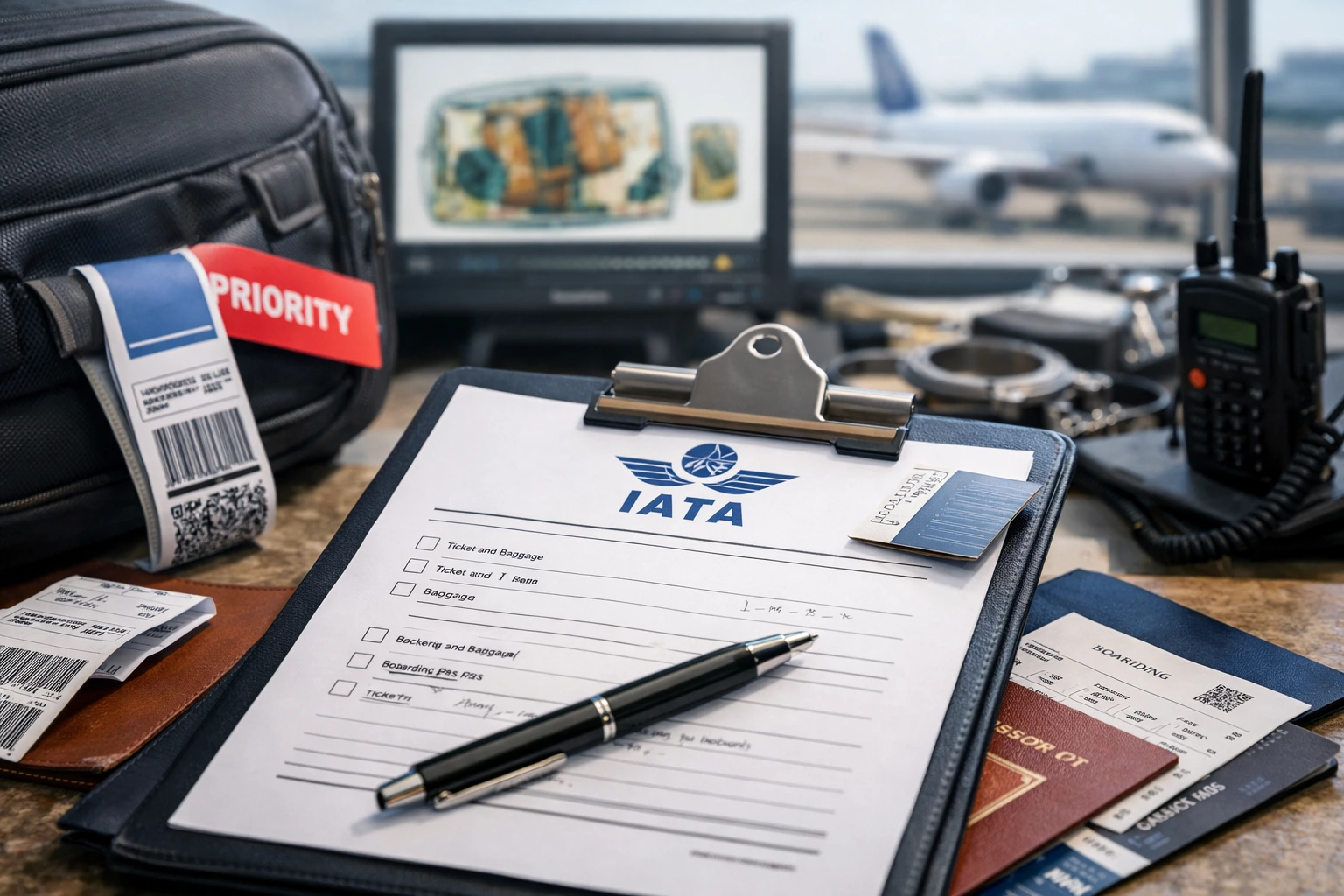
IATA Resolution 739 – Baggage Security Control
IATA Resolution 739 was introduced to mandate positive passenger–baggage matching on international flights. In practice, it requires that no checked baggage is carried on board without its owner being on the flight unless the bag is re-screened. The rule was adopted by the IATA Passenger Services Conference (PSC) at its 13th meeting (circa 1990–91) and remains in force as an indefinite Type B resolution. Resolution 739 effectively formalizes the process known as Positive Passenger Baggage Matching (PPBM). It echoes global security standards (e.g. ICAO Annex 17) and obliges carriers to develop systems so that every bag on an aircraft is either matched to a boarded passenger or subjected to additional security screening.
Key Requirements and Background
IATA Res. 739 explicitly states that “Members shall endeavour to cooperate to develop common methods to ensure that for international flights they do not transport the baggage of passengers who are not on board the aircraft unless the baggage separated from passengers is subjected to other security control measures”. In practical terms, if a passenger fails to board (a no-show), any of their checked bags must be identified and either offloaded or re-screened before takeoff. In parallel, ICAO Annex 17 (2022) now contains Standards 4.5.4 and 4.5.6 with the same intent: carriers must not transport baggage of absent passengers unless screened as “unaccompanied”. IATA’s own guidance reinforces this by advising that no-show baggage should be re-identified as unaccompanied and subjected to appropriate security controls (such as confirming the initial screening) if it is still to be flown.
A convenient summary of these mandates is shown below:
Regulation / Standard
IATA Resolution 739 (1991)
Requirement
No international checked bag may travel without its owner onboard unless it is subjected to security control.
Source
IATA PSC Resolutions Manual (PSCRM).
Regulation / Standard
ICAO Annex 17 Std. 4.5.4 (2022)
Requirement
Carriers must not transport baggage if passenger is not on board, unless bag is identified as unaccompanied and screened.
Source
ICAO Annex 17 (security).
Regulation / Standard
IATA Baggage Security Guidance
Requirement
No-show baggage should be marked “unaccompanied” and re-screened (or offloaded) before flight.
Source
IATA Hold Baggage Security Procedures.
This convergence of industry and regulatory rules reflects lessons learned from past incidents and ensures a standard baggage reconciliation process. Resolution 739 itself is brief (two clauses) and does not list an expiry date (it is indefinite). No subsequent PSC circular or public source indicates any substantive amendments; the rule remains as adopted at PSC-13 (circa 1991).
Technical Scope and Structure
Resolution 739 is a Type B resolution, meaning it is mandatory on IATA member airlines (and binding on their interline partners). Its “application” covers the interline carriage of baggage for international flights, and it obliges both airlines and handling agents to follow the prescribed procedures. In practical terms, the technical implementation involves the airline’s Departure Control System (DCS) and Baggage Handling System (BHS) working together:
Baggage Data Capture:
At check-in, each passenger’s bag is tagged with a barcode or RFID and entered into the DCS, which logs the passenger’s identity and the number of bags. Modern systems record a “baggage‐to‐passenger count” message so that the loading process knows how many bags belong to each boarded person.
Reconciliation Check:
At gate‐closing, software compares the total bags checked-in (per the DCS) against passengers boarded. Any surplus bags indicate no-shows. The IATA Airport Development Manual describes how, upon flight closure, a program “constantly check[s]” these counts and offloads all bags belonging to absent passengers.
Tagging Unaccompanied Bags:
No-show bags are then re-labeled as unaccompanied (commonly coded as “UNAC” or “RUSH”) so ground crews and security know they require special handling. These bags should either be removed from the aircraft or passed through additional screening before departure.
Technically, no new type of bag tag was introduced by Res. 739; it relies on standard baggage tags and existing IATA message formats. However, it did spur enhancements in DCS/BRS (Baggage Reconciliation System) software. Airlines now routinely receive Loaded Bag and Baggage House Count messages that allow them to detect and correct mismatches. In essence, Res. 739 leverages existing data flows to enforce a security check: each bag must link to a boarded passenger or be treated as a potential threat.
Implementation Guidelines
In operational terms, implementing Res. 739 involves several steps and controls. Airlines and airports typically follow these guidelines:
Baggage Scanning (100% Screening):
All checked bags (international and domestic) must be screened to the certified standard before loading. This is a parallel requirement (IATA RP 1745a, ICAO Annex 17), and it is the baseline for any unaccompanied bag policy.
Passenger–Bag Matching:
During boarding, the DCS assigns each boarded passenger’s baggage tags to the onboard list. Ground crew or software match the final passenger list to the bag count. Any discrepancy (bags without a matching passenger) triggers an alert. Modern systems may use hand-held scanners or RFID to verify bag‐to‐passenger linkage on the tarmac.
Handling No-Show Bags:
If a passenger does not board:
Option A (Offload): The simplest compliance method is to remove all of that passenger’s checked bags before pushback. This guarantees they never fly without the owner. After removal, the bags must be re-entered into the baggage system (often with a priority label for the next flight).
Option B (Security Control): If the airline decides to carry the bag, it must be officially marked as an unaccompanied bag and re-screened. IATA guidance advises that no-show baggage be “re-identified as unaccompanied” and go through additional security checks (for example, verifying the quality of its prior screening). Only after such security clearance may it be forwarded, often on a later flight, to meet the passenger. (This procedure requires an agreed protocol; some airlines offload all no-show bags as a matter of policy.)
Notification and Record-Keeping:
Airlines should notify the flight crew and airport security of any re-identified baggage. The unaccompanied bag’s status must be recorded in messaging (e.g. by attaching a standard UNAC/RUSH tag) and communicated via baggage messages (IATA RP 1745 and 1745a cover these codes).
Interline Considerations:
All handling agents (e.g. at transfer points or non-IATA carriers) must follow the same protocol. Resolution 739’s second clause explicitly binds non-Member agents to these procedures. In practice, carriers include PPBM clauses in interline agreements and ensure offloaded bags are not unwittingly forwarded.
These measures are summarized in IATA’s baggage standards. For example, IATA’s baggage manual notes that if a passenger’s bag was loaded but the passenger “fails to board,” then airport staff must be informed before pushback and the bag removed. In the 2024 Hold Baggage Security Procedures, the rule is restated: no-show bags should be treated as unaccompanied and “subjected to appropriate security controls” if still carried.
Implementation Checklist (example):
- Verify each passenger’s total checked bags against bags boarded.
- If mismatch is detected: identify the no-show passenger(s).
- Offload or re-screen all bags of no-show passengers.
- Tag re-screened bags as UNAC/RUSH and log into the reconciliation system.
- Update flight and cargo manifests to reflect offloaded or expedited baggage.
Benefits for Airlines and Security
The main purpose of Res. 739 is security – to prevent scenarios where a dangerous item flies on without its owner. By enforcing PPBM, it greatly reduces the risk of unchecked, dangerous items on aircraft. Beyond security, there are operational and compliance benefits:
Regulatory Compliance:
Many national regulators (EU, US TSA, Canadian CATSA, etc.) require baggage reconciliation. By following Res. 739, airlines meet or exceed these legal standards, avoiding fines or sanctions. The formalization of PPBM in IATA policy helps carriers demonstrate compliance during audits.
Operational Integrity:
Accurate bag matching reduces mishandled baggage events. When bags are tracked and matched properly, lost or misrouted bags drop, improving on-time performance (because rush-handling unclaimed bags can cause delays) and passenger satisfaction.
Risk Management:
If an incident does occur, documented PPBM logs provide a clear audit trail showing that no policy was violated. In liability terms, the airline can show it did everything required to secure baggage.
Customer Trust:
Reassuring travelers that unscreened baggage is never flown alone strengthens the airline’s security reputation. Some carriers promote their PPBM compliance as a passenger service.
In practice, airlines often report that Res. 739 requires relatively little additional work if they already have a robust baggage reconciliation system. With modern DCS/BRS technology and RFID, tracking every bag is straightforward. The procedures pay for themselves in efficiencies: for example, automatically detecting an extra bag allows ground staff to correct errors before pushback, avoiding last-minute scramble or misloads.
Auditability and Record-Keeping
Because Res. 739 is a “paper rule,” airlines must maintain records proving they followed it. In practical terms, auditability comes from:
DCS/BRS Logs:
Every passenger and bag count is recorded. Airlines can print a baggage reconciliation report that shows “boarded pax: X, loaded bags: Y.” Any discrepancy (X≠Y) is flagged and followed up in the system.
Baggage Tag Scans:
Modern airports scan bag tags at each stage (check-in, sortation, loading). These scans create a timestamped record for each bag’s journey. If a bag is offloaded, that action (scan or manual entry) is noted.
Security Screening Records:
If a no-show bag is re-screened, that too is documented. The screening equipment often logs each item.
Internal Audits:
IATA’s Recommended Practice 1739 and ICAO Annex 17 both imply airlines should periodically check PPBM effectiveness. Airlines may run drills or sample audits of flights to ensure no-show bags were handled correctly.
Because the resolution text is short, the proof of compliance lies in the operational data. In an audit, regulators will check that no passenger’s bag was loaded without the passenger, or if it was, that it was properly screened or offloaded. Any exceptions must be justified (e.g. in some cases a passenger on a connecting flight may have his bag sent ahead with prior security clearance). Good practice is to enable real-time alerts: for example, if load count exceeds boarded count after gate closure, an automatic hold prevents pushback until resolved. :contentReference[oaicite:12]{index=12}
Real-World Use Cases
Case Study – Flight Closeout:
IATA illustrates a common scenario: a fully booked flight closes, and the DCS shows passenger Mr. X did not board but had 2 bags checked-in, while his assigned seats are empty. The BRS flags “1 extra bag” for this flight. Ground staff locate those 2 bags, remove them from the hold, and load them on Ms. Z’s later flight after re-screening. Passengers on the flight proceed, knowing all remaining bags have verified owners.
Historical Incidents:
Resolution 739 is largely a response to 1980s/90s security breaches. In the Pan Am 103 bombing (1988), a suitcase checked by a passenger in Malta flew on without him (because he had missed connecting flights). Strict PPBM might have prevented that. Similarly, the Air India Flight 182 bomb was placed in unaccompanied luggage. These events prompted governments and IATA to codify baggage-passenger matching. (As a result, some countries even enacted laws requiring offload of no-show bags on all commercial flights.)
Global Adoption:
Today, PPBM is standard worldwide on international flights. For example, EU Regulation 2015/1998 requires Positive Match on all international routes. U.S. TSA’s Secure Flight mandates similar checks, and most major airlines use automated Baggage Reconciliation Systems. IATA’s Res. 739 simply provides the industry framework. In practice, an airline’s ground system will often generate a “no-show report” after each flight: if any discrepancies are found, that flight is put on hold until baggage issues are resolved. This procedure is also the backbone of tracking mishandled baggage: by the time baggage hits the belt, it is guaranteed to match a passenger (or have been screened as an exception).
Table 1. Summary of no-show baggage handling rules (IATA vs ICAO vs IATA guidance) — these collectively establish that any baggage without a boarded passenger must receive extra security attention.
Summary
In summary, IATA Res. 739 is the industry rule that underpins baggage reconciliation. It was first adopted at PSC meeting 13 (around 1990–91), and it remains active and indefinite. The resolution itself is short, but its impact is extensive: it codifies the principle that no checked bag flies without its owner (unless re-screened). This has become standard practice globally, enforced through airline DCS/BRS systems, and it meshes with ICAO security standards. Airlines benefit from improved security and reduced mishandling, and regulators can verify compliance via electronic reconciliation records. In real operations, Res. 739 means that every flight either arrives with each bag accounted for by a passenger or carries only those bags that have gone through explicit security controls.
Sources and References
[1] IATA PSC Resolutions Manual (PSCRM) and related IATA publications.
[2] Historical references to PSC meeting 13 (circa 1990–91).
[3] Res. 739 status and classification (Type B resolution).
[4] IATA guidance documents and interline baggage standards.
[5] ICAO Annex 17 (Security) — Standards relevant to PPBM.
[6] IATA Hold Baggage Security Procedures (2024) and related HB guides.
[7] IATA and industry manuals referenced in the uploaded source.
[8] IATA Airport Development Manual and baggage reconciliation examples.
IATA guidance on baggage standards for interline — https://www.iata.org/contentassets/e7a533819be440edbb1e49da96e0f2a8/guidance-document-on-baggage-standards-for-interline.pdf
Hold Baggage (HB) Security Procedures (IATA) — https://www.iata.org/contentassets/1998554ac6624b97a2de8418938eaade/hold-baggage-security-procedures-2024.pdf
IATA Airport Development Reference Manual 9th Edition (referenced in source).

Author: John Karume
John Is a Baggage Operations and Systems expert with 15+ years of airline experience who leverages People, Process, Technology to deliver measurable improvements. He builds innovative tech solutions, from Baggage Systems, LMS and educational sites to business process automation and full-stack software integrations—and is a Power BI, Excel, and Tableau guru as well as a full-stack web and software developer. A Certified Lean Black Belt, Business Analyst, Aviation Auditor and Quality Control specialist, John combines operational insight with technical delivery to keep systems efficient and baggage moving on time.
Contact: john.karume@baggagelogistics.com | https://www.fiverr.com/s/o8G3q2x
Comments (0)