


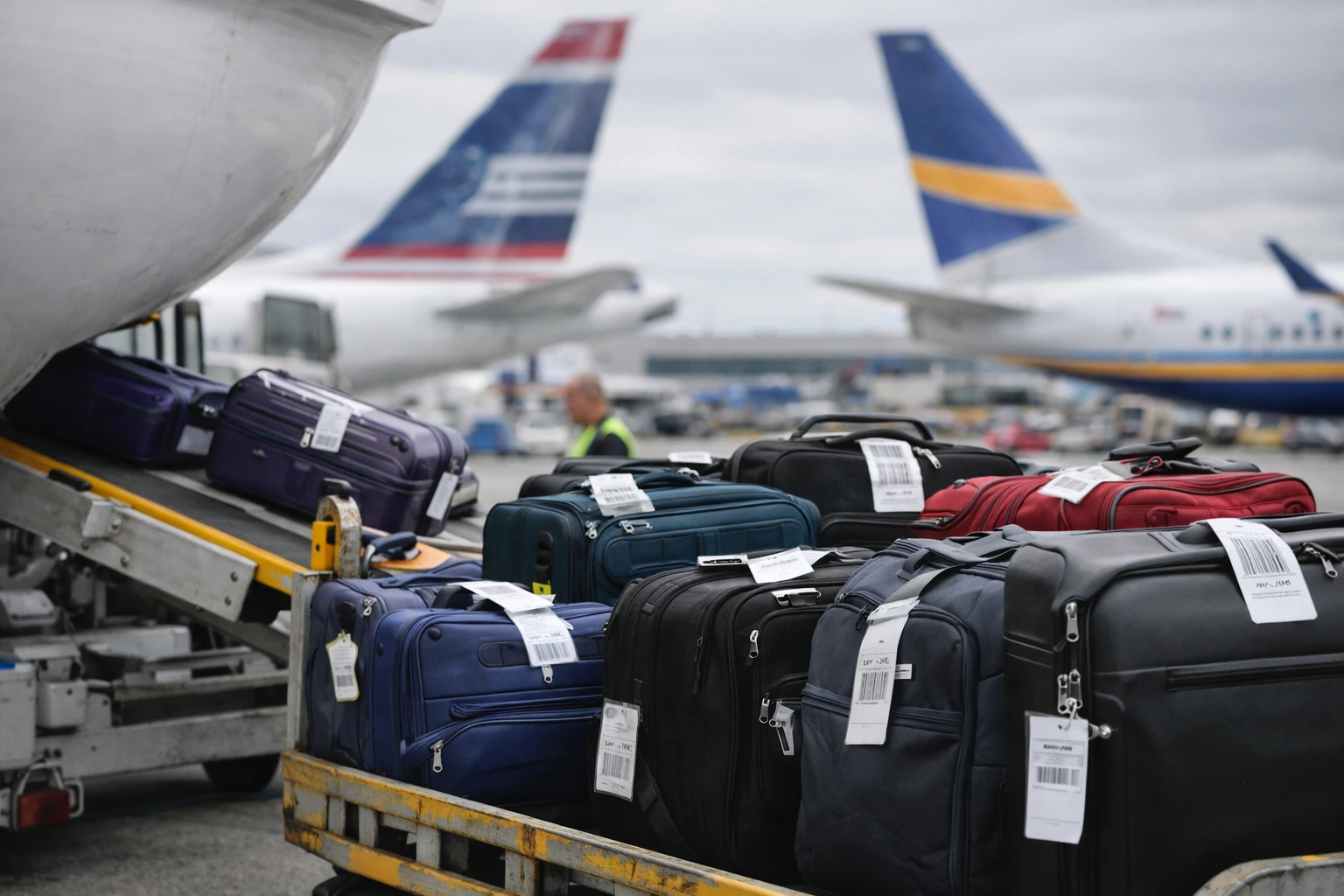
Resolution 709 — Baggage Transfer Message (BTM)
The Baggage Transfer Message (BTM) is an IATA Passenger Services Conference Type-B message used to report interline baggage transfers between carriers. In practical terms, after a flight arrives (or shortly after departure depending on local workflow), the sending carrier sends a BTM to the next carrier in the passenger’s itinerary listing all checked bags that will connect to onward flights. This updates the receiving carrier’s baggage system with expected bag tag numbers, flight routing and, when provided, PNR/passenger data so downstream systems know exactly which bags to expect for each onward flight.1
Background & Governance
Resolution 709 was adopted under the IATA Passenger Services Conference (PSC) process at PSC(22) and took effect on 1 January 2002. The resolution appears in the Passenger Services Conference Resolutions Manual and is treated as an industry standard for interline baggage transfers.2
IATA reserves its PSC resolutions as member-controlled standards; Resolution 709 has remained in its original form since adoption with no published amendment circulars altering the text in available PSC/manual transcriptions.2
Technical Structure & Messaging Standards
Resolution 709 mandates use of the legacy Type-B (airline telex) messaging format for BTMs. The precise syntax, element sequence and segment definitions for the BTM are defined in IATA/ATA Recommended Practice RP 1745 (Baggage Information Messages), which lists the BTM among the family of baggage messages (BSM, BPM, BUM, BNS, BCM, BMM, BRQ, etc.). RP 1745 prescribes headers, field separators, office/function designators (OFDs), and the element ordering that receiving systems must parse and validate.3
Type-B BTMs are conventionally transported via established messaging networks (SITA, ARINC or equivalent) using standardized addressing — for example, an OFD/station designator in the header indicates the intended recipient baggage office. Because RP 1745 standardises structure and codes, a BTM from one carrier can be ingested by another carrier’s baggage reconciliation or sorter system without ad-hoc field mapping.3
Common BTM Elements
- Header / OFD / station / message version (e.g. .HDL / .V style header per RP1745).3
- Inbound flight: carrier, flight number, date, origin (.I).
- Outbound / connecting flight: carrier, flight number, date, destination (.F).
- Baggage tag(s): ten-digit license plate numbers for each transfer bag (.N).
- Passenger name: surname/given name (.P), where provided.
- PNR / booking reference: locator (.L), when transmitted.
- Termination: message end indicator as specified in RP1745.
These fields create a machine-readable link from each bag tag to the passenger and the inbound/outbound flight details so receiving systems can preload and route bags appropriately.3
Operational Workflow & Implementation
Typical end-to-end workflow:
- Check-in: Baggage Source Message (BSM) records bag tag numbers and links to the passenger and itinerary.
- Post-flight / post-departure: Sending carrier’s DCS/baggage system compiles connecting bag tags and generates a BTM in RP1745 format.
- Transmission: BTM is sent as a Type-B message to the receiving carrier’s OFD address via SITA/ARINC or equivalent.
- Ingestion & sorting: Receiving carrier’s baggage reconciliation or BHS ingests the BTM, preloads bag barcodes into load/sort plans and routes bags to the onward flight.
- Follow-up messaging & scans: Subsequent BPM/BUM scans and, if necessary, BNS tracing messages complete the custody trail.
Implementation checklist for carriers: identify transfer bags in DCS, generate RP1745-compliant BTMs immediately after departure (or per local SLA), transmit to the partner OFD, perform bilateral parser testing, and log all exchanges for audit and reconciliation.2
Relation to Resolution 753 (Baggage Tracking) & Auditability
BTMs are complementary to IATA Resolution 753 (mandatory scanning at defined points). Combined, BTMs plus four-point scanning (check-in, transfer, handover to next flight, final arrival) form an auditable custody trail that improves traceability and assists fast mishandled-baggage resolution.1
For auditability, carriers typically keep logs of BTMs sent and received and reconcile those logs against flight manifests and scan events. Missing or malformed BTMs surface through routine reconciliation or downstream system exceptions, making non-compliance operationally apparent to interline partners.2
Benefits to Airlines & Passengers
- Reduced mishandling: downstream systems know which bags to expect and where to route them.
- Faster tracing and customer service: messaging chains reduce manual work and speed claim resolution.
- Operational efficiency: automated load planning and sorter rules reduce manual intervention and gate delays.
- Auditable records: standardized messages provide a permanent record for investigations and interline settlements.
These advantages depend on consistent RP1745 formatting, reliable Type-B transmission and appropriate scanning practices at transfer points.3
Real-World Use Cases & Stakeholders
BTMs are used across major carriers, alliances, hubs and handling agents to coordinate interline transfers. Common scenarios include: Carrier X at hub B sending a BTM to Carrier Y for onward connections; shared-use or common-use baggage sortation at large airports ingesting BTM data to route bags; and WorldTracer or centralized tracing services relying on BTMs and BNS/BPM messages to populate baggage histories.2
Challenges, Limitations & Modernization
Limitations of the current BTM ecosystem include dependence on legacy Type-B networks (cost/latency), occasional data completeness issues during IRROPS (replaced tags, unexpected rebookings), and variable ground-handler integrations. The industry is pursuing modernization (XML/AIDM/Type-X approaches) while retaining backward compatibility with Type-B for existing operations.1
Figure 1 — Typical airport baggage handling
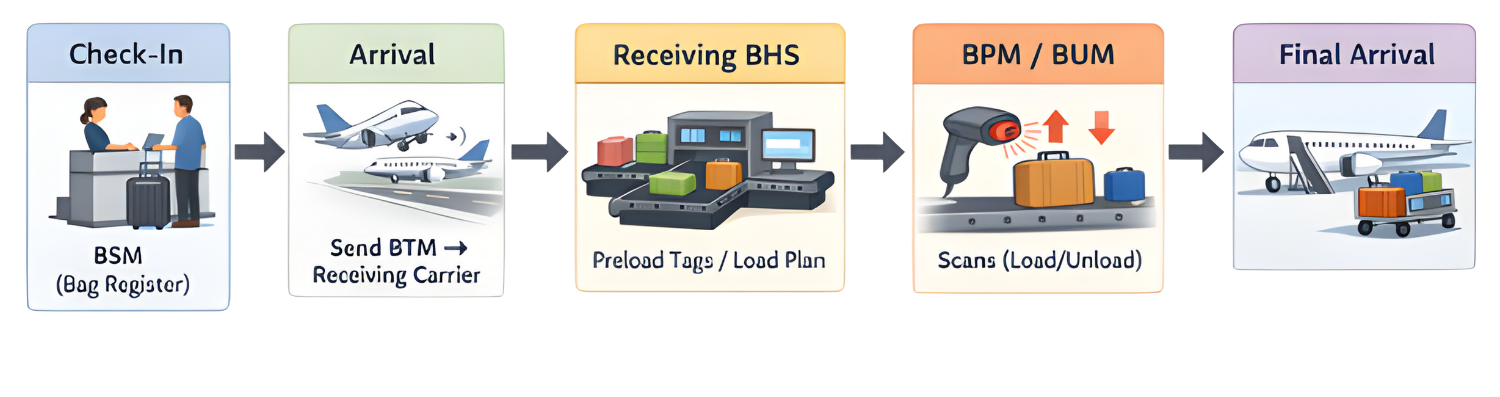
Typical workflow: check-in → BSM at origin; arrival → BTM from sending carrier to receiving carrier; receiving BHS preloads tags → BPM/BUM scans → final arrival. (Insert site-specific diagram or screenshot as required.)
References
- IATA — Guidance document on baggage standards for interline (Baggage Standards guidance).
https://www.iata.org/contentassets/e7a533819be440edbb1e49da96e0f2a8/guidance-document-on-baggage-standards-for-interline.pdf - Passenger Services Conference Resolutions Manual / PACRM — Resolution 709 (PSC(22), effective 1 January 2002).
- IATA RP 1745 — Baggage Information Messages (BTM, BSM, BPM, BUM, BNS, BCM, BMM, BRQ) — element definitions and format.
- IATA — Baggage program and standards overview (standards landing page).
https://www.iata.org/en/programs/ops-infra/baggage/standards/

Author: John Karume
John Is a Baggage Operations and Systems expert with 15+ years of airline experience who leverages People, Process, Technology to deliver measurable improvements. He builds innovative tech solutions, from Baggage Systems, LMS and educational sites to business process automation and full-stack software integrations—and is a Power BI, Excel, and Tableau guru as well as a full-stack web and software developer. A Certified Lean Black Belt, Business Analyst, Aviation Auditor and Quality Control specialist, John combines operational insight with technical delivery to keep systems efficient and baggage moving on time.
Contact: john.karume@baggagelogistics.com | https://www.fiverr.com/s/o8G3q2x
Comments (0)